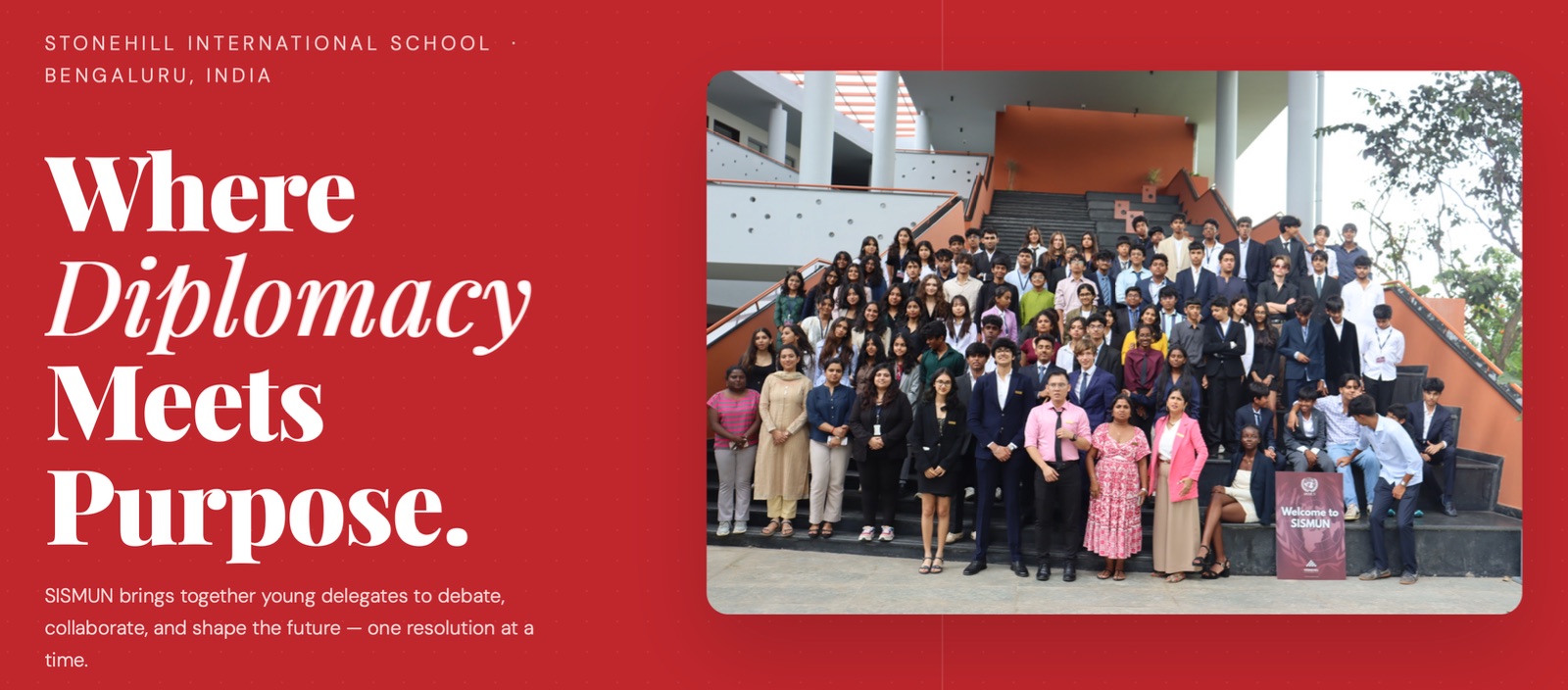
From 25 to 27 Sep 2026, Stonehill International School Model United Nations (SISMUN 2026) brought Model UN delegates together in Bangalore, India. It was for high school students aged 10 and over, and the organisers expected about 231 delegates. There were 7 committees, including ADHOC and Durandhar Crisis Council. ADHOC debated “The Ad Hoc committee is unlike anything else at SISMUN 2026. Where every other committee gives delegates weeks to research, prepare position papers, and refine their arguments — Ad Hoc gives you nothing. No agenda. No assigned country. No background guide. Just you, the room, and whatever the dais reveals when the gavel drops on day one. This format is deliberately designed to strip away the safety net of preparation and test the qualities that define truly exceptional delegates: the ability to think critically under pressure, construct arguments on the fly, read a room, and pivot strategy in real time. It is the closest simulation to the unpredictable nature of real-world diplomacy that a Model UN conference can offer. Past Ad Hoc committees at MUN conferences have covered everything from historical crisis scenarios to fictional geopolitical settings to real-world events frozen at a specific moment in time. The only guarantee at SISMUN 2026 is that it will challenge you in ways you didn't expect”, and Durandhar Crisis Council debated “Information Integrity vs Misinformation — who controls the narrative controls the crisis”.
ADHOC
Crisis
The Ad Hoc committee is unlike anything else at SISMUN 2026. Where every other committee gives delegates weeks to research, prepare position papers, and refine their arguments — Ad Hoc gives you nothing. No agenda. No assigned country. No background guide. Just you, the room, and whatever the dais reveals when the gavel drops on day one. This format is deliberately designed to strip away the safety net of preparation and test the qualities that define truly exceptional delegates: the ability to think critically under pressure, construct arguments on the fly, read a room, and pivot strategy in real time. It is the closest simulation to the unpredictable nature of real-world diplomacy that a Model UN conference can offer. Past Ad Hoc committees at MUN conferences have covered everything from historical crisis scenarios to fictional geopolitical settings to real-world events frozen at a specific moment in time. The only guarantee at SISMUN 2026 is that it will challenge you in ways you didn't expect.
Durandhar Crisis Council
General Assembly
Information Integrity vs Misinformation — who controls the narrative controls the crisis
National Security vs Civil Liberties — how far is too far in the name of safety?
Media Influence & Narrative Control — the press is a weapon as much as a watchdog
IMO
International Maritime Organisation · General Assembly
Freedom of navigation: How can the international community uphold UNCLOS provisions guaranteeing innocent passage through international straits against state interference?
Energy security: What mechanisms can reduce global dependence on the Strait of Hormuz as a single point of failure for energy supply chains?
Tanker attacks & vessel seizures: How should the IMO respond when commercial vessels are attacked or seized for geopolitical leverage?
SOCHUM
General Assembly
Platform accountability: Should social media companies be legally liable for misinformation spread on their platforms?
State-sponsored disinformation: How should the international community respond to governments that weaponise misinformation?
Content moderation standards: Who decides what constitutes misinformation, and how do we prevent censorship?
UNDP
UN Development Programme · General Assembly
Media access in conflict zones: How can the international community ensure journalists have safe and unimpeded access to conflict areas to report accurately?
Verification & fact-checking: What international standards and infrastructure exist for verifying conflict reporting, and how can they be strengthened?
Social media amplification: How do platforms' content policies and algorithms affect the spread of misinformation about the conflict, and what responsibilities do they bear?
UNSC
UN Security Council · General Assembly
Establishing the facts: What actually happened to the Su-35, and how can the Security Council establish an independent account when all parties have strong incentives to control the narrative?
Preventing immediate escalation: What emergency mechanisms — ceasefires, military hotlines, buffer zones — can the Council invoke to reduce the risk of further incidents?
NATO's Article 5 obligations: If NATO member state assets were involved in the downing, does this trigger collective defence obligations — and how does the Council respond to that possibility?
WHO
World Health Organization · General Assembly
Vaccine hesitancy drivers: What are the root causes of hesitancy — mistrust of institutions, religious beliefs, misinformation — and how should responses be tailored?
The infodemic: How can the WHO and member states coordinate to counter health misinformation at scale without becoming arbiters of truth?
COVAX & vaccine equity: Wealthy nations are vaccinating rapidly while the Global South lags — how does inequity fuel mistrust and hesitancy?